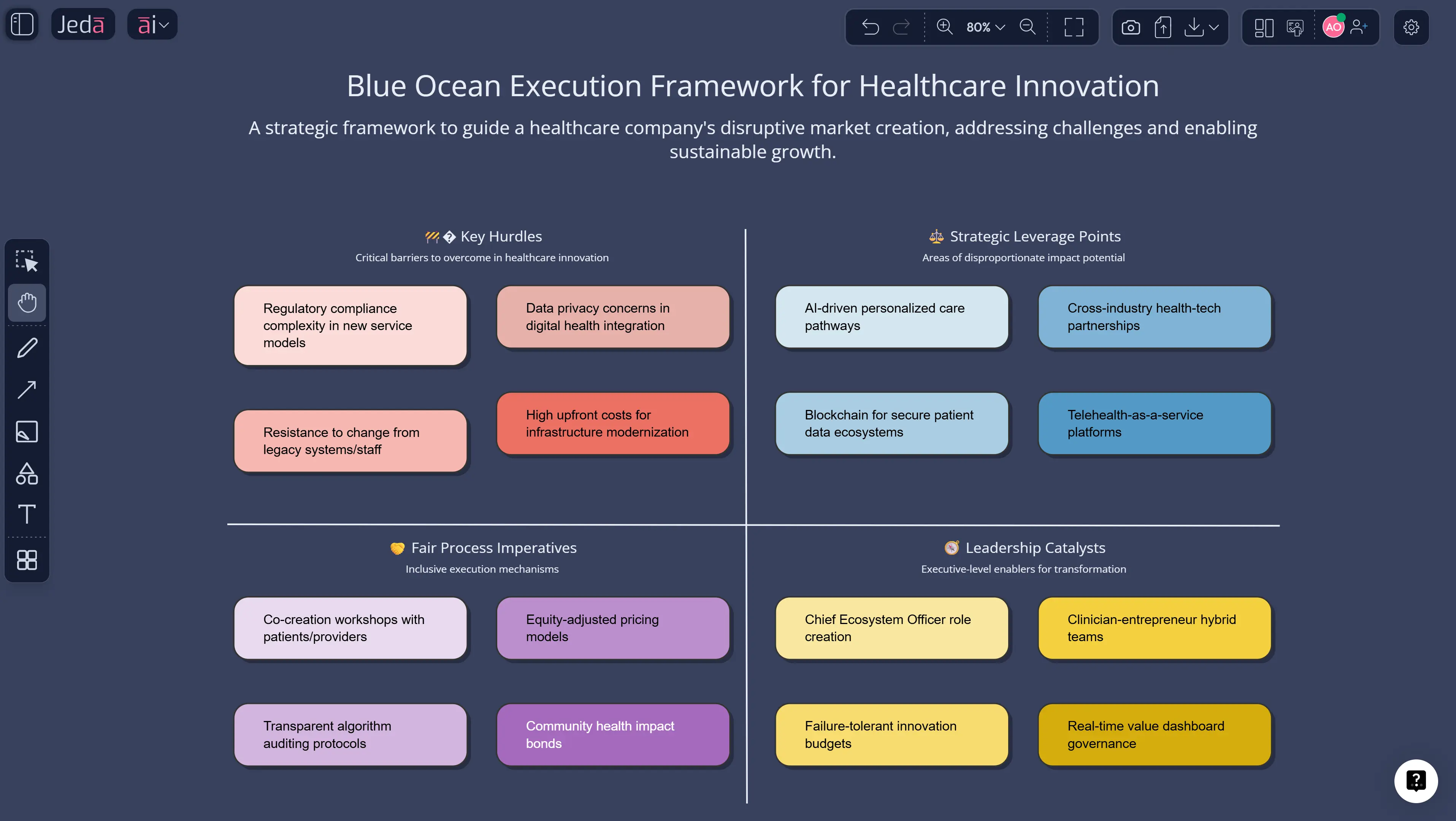
A strategy can be smart and still fail. In fact, some of the smartest strategies fail precisely because they ask an organization to stop behaving like itself. New market logic sounds exciting in the workshop. Then the company runs into the usual wall: people do not see the need, resources feel tight, motivation fragments, and politics wakes up right on schedule. That is why execution principles matter in Blue Ocean work. They are not decorative. They are the difference between strategic brilliance and expensive strategy fiction.
In the Blue Ocean tradition, execution is shaped by ideas such as the four hurdles to strategy execution, tipping point leadership, and fair process. In Jeda.ai, the Execution Principles framework acts as a working matrix that pulls those execution questions into one visual board: what stands in the way, where disproportionate influence sits, and how buy-in gets built into the move itself. Inside Jeda.ai, an AI Workspace and AI Whiteboard designed for editable strategy, execution stops being an afterthought.
Because Jeda.ai includes 300+ strategic frameworks and is used by 150,000+ users, the framework can live right beside your Strategy Canvas, ERRC decisions, and leadership boards on the same Visual AI surface. That is where formulation and execution finally stop pretending to be separate planets.
What are Execution Principles in Blue Ocean work?
In Blue Ocean thinking, execution principles address the human and organizational risks that appear once a new strategic move is chosen. Kim and Mauborgne’s tools make this concrete. The four hurdles to strategy execution identify cognitive, resource, motivational, and political barriers. Tipping point leadership argues that change does not need to move the mass first; it can focus on the people, acts, and activities with disproportionate influence. Fair process builds buy-in through engagement, explanation, and clarity of expectation.
Put those together and a clearer idea emerges: strategy execution is not only about rollout plans. It is about whether people understand the shift, believe it is fair, and see how to act inside it.
That is the point of the Execution Principles board in Jeda.ai. It gives teams a visible place to map the hurdles, identify leverage points, and design execution choices before the strategy enters the organization like an announcement and leaves like a rumor. In an AI Whiteboard, those pieces can remain connected inside the same AI Workspace where the strategy itself was created.
Why use Execution Principles with AI?
Because execution breakdowns are rarely caused by one thing.
People do not adopt a new move because they are not convinced the old world is really over. Or because resources feel misaligned. Or because incentives are wrong. Or because quiet political resistance is already underway. Usually it is some cocktail of all four, which is why teams struggle to discuss execution clearly.
AI helps by structuring the mess. In Jeda.ai, AI can help surface likely execution barriers, organize them by type, propose leverage points, and map where fair process or tipping point logic may matter most. That does not replace judgment. It gives judgment a cleaner surface to work on.
- Map execution risk early
Use AI to surface cognitive, resource, motivational, and political hurdles before rollout turns them into surprises.
- Find disproportionate influence
Apply tipping point logic to the people, acts, and activities that can unlock change faster than broad generic programs.
- Build shared buy-in
Keep the execution board in a collaborative Jeda.ai AI Workspace where leaders and operators can see the same logic.
- Extend with AI+
Use AI+ to deepen one execution problem at a time, refine interventions, or convert the board into a more detailed action plan.
And there is a practical bonus. Execution conversations tend to sprawl. The board keeps them constrained enough to be useful and broad enough to stay honest. That is rarer than it should be.
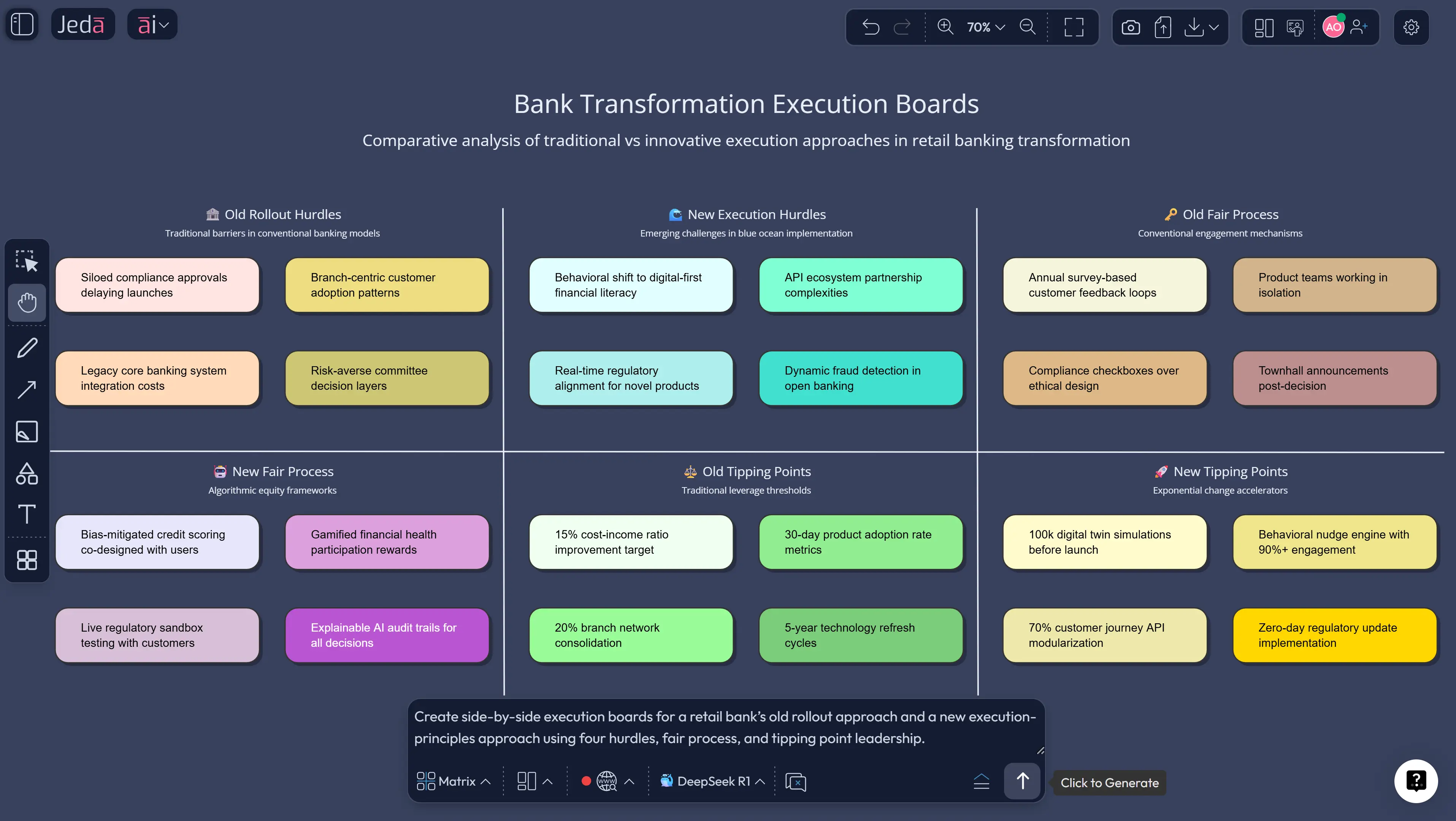
How to create Execution Principles in Jeda.ai
Because Execution Principles sits within the Blue Ocean framework family in Jeda.ai, the AI Menu recipe is the best place to start. The Prompt Bar is helpful when your industry has a unique execution context or when you want a second pass focused on a narrower set of hurdles.
Method 1: Recipe Matrix
Open Jeda.ai, enter your AI Workspace, and click the AI Menu. Under Strategy & Planning, choose Blue Ocean Framework, then select Execution Principles. Enter the strategy shift you are trying to execute, the organizational setting, and the main resistance or adoption concerns already visible. Then choose your layout and AI model.
This method works well when you want a structured board that captures execution risk and response options in one place.
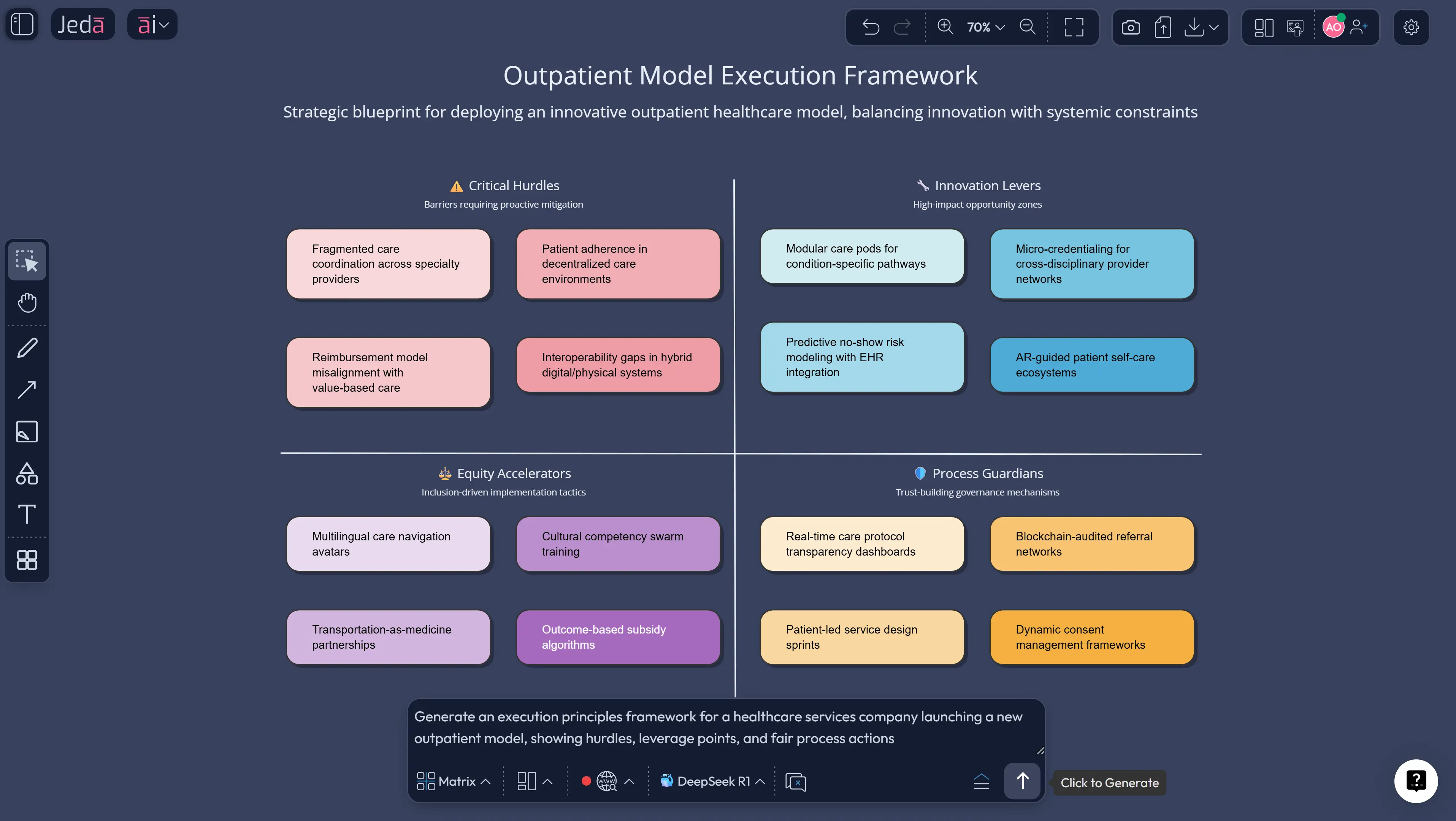
Method 2: Prompt Bar
Open the Prompt Bar at the bottom of the canvas and select the Matrix command. Then write a prompt that names the strategic move and the execution barriers. For example: “Create an execution principles board for a hospital group launching a faster, lower-friction outpatient model, focusing on staff skepticism, resource constraints, incentive misalignment, and political resistance from incumbent units.”
After generation, edit the hurdles and responses directly, use AI+ to deepen any barrier or intervention, and use Vision Transform if you want to convert the board into a rollout plan, flowchart, or leadership action map. Export from Jeda.ai in PNG, SVG, or PDF when you need to share it.
- Open your AI Workspace
Log in to Jeda.ai and enter the workspace where you want to build the Execution Principles board.
- Choose the Blue Ocean recipe
Click AI Menu, open Strategy & Planning, choose Blue Ocean Framework, and select Execution Principles.
- Describe the strategic move
Enter the blue ocean initiative, the organizational setting, and what kind of change the strategy requires.
- Map the likely hurdles
Generate a first draft that organizes cognitive, resource, motivational, and political barriers to execution.
- Add leverage points and fair process actions
Refine where tipping point influence exists and how engagement, explanation, and expectation clarity should be designed.
- Run a custom Prompt Bar version
Use the Matrix command to create a second board focused on a business unit, region, or narrower rollout problem.
- Use AI+ to deepen one barrier
Tap the AI+ button to expand root causes, rewrite interventions, or connect the issue to leadership and operating rhythm.
- Export and keep the live version
Export the board as PNG, SVG, or PDF while keeping the editable strategy source in Jeda.ai.

Execution Principles template and example
Take a hospital network trying to launch a lower-friction outpatient service model.
The strategic logic is strong. Faster access. Simpler navigation. More transparent pricing. Better patient continuity. On paper, everyone agrees.
Then execution begins. Clinical staff are not convinced the old model needs to change. Budget owners worry the new model will cannibalize existing units. Middle managers are unclear about what they are expected to stop doing. A few influential skeptics quietly frame the move as another leadership fashion cycle.
That is exactly when an Execution Principles board earns its place.
In Jeda.ai, the team can map the cognitive hurdle, resource hurdle, motivational hurdle, and political hurdle on one AI Whiteboard. Next to that, it can mark tipping-point leverage points: which frontline proof cases would shift belief fastest, which scarce resources could be concentrated for maximum effect, which kingpins matter most, and what political blocks must be surfaced early. Then fair process actions can be added: who needs engagement, what rationale must be explained, and where expectation clarity is weak.
Now execution becomes a designed system, not a wish.
Best practices for stronger execution design
Common mistakes to avoid
The first mistake is treating execution as a communication problem only. Communication matters. But belief, incentives, resources, and politics matter just as much.
Second, many teams try to move the whole organization evenly instead of identifying disproportionate influence points.
Third, some leaders ask for buy-in without designing fair process. People may comply publicly and resist privately.
Fourth, teams often name the hurdles but fail to assign concrete interventions to each one.
And finally, execution work is often separated from the strategy board itself, which makes the transition from idea to action far sloppier than it needs to be.
Frequently asked questions
- What are execution principles in Blue Ocean Strategy?
- Execution principles are the ideas and tools that help a new strategic move get carried out inside the organization. In Blue Ocean work, that includes the four hurdles to strategy execution, tipping point leadership, and fair process.
- What are the four hurdles to strategy execution?
- Kim and Mauborgne identify four common barriers: the cognitive hurdle, the resource hurdle, the motivational hurdle, and the political hurdle. These obstacles make even strong strategies hard to execute if they are not addressed early.
- What is tipping point leadership?
- Tipping point leadership is a Blue Ocean concept that focuses on people, acts, and activities with disproportionate influence. Instead of trying to move the entire organization equally, it aims to shift the few points that can change the many faster and at lower cost.
- What is fair process?
- Fair process is the practice of building buy-in through engagement, explanation, and clarity of expectation. It helps people trust the process behind strategic decisions, which improves voluntary cooperation during execution.
- Can I create an execution principles board with AI?
- Yes. In Jeda.ai, you can generate an Execution Principles board through the Blue Ocean recipe or by selecting the Matrix command in the Prompt Bar. AI helps organize hurdles, leverage points, and execution responses.
- Why use an AI Workspace for execution planning?
- An AI Workspace keeps the strategy and execution logic together. Teams can see the move, the risks, the interventions, and the changing rollout context on the same editable board instead of spreading it across separate documents.
- Who should use the Execution Principles framework?
- It is especially useful for strategy consultants, business leaders, transformation teams, project managers, and founders leading a strategic shift that requires organizational behavior to change.
- Does Jeda.ai support sharing and exporting the execution board?
- Yes. Jeda.ai supports collaboration in the AI Whiteboard and lets you export the final board as PNG, SVG, or PDF while keeping the editable source intact.
Sources & further reading
- [1]
Kim, W. Chan; Mauborgne, Renée (2004) . “Blue Ocean Strategy” Harvard Business Review.
View Source ↗ - [2]
Kim, W. Chan; Mauborgne, Renée (2025) . “Four Hurdles to Strategy Execution” Blue Ocean Strategy Tools.
View Source ↗ - [3]
Kim, W. Chan; Mauborgne, Renée (2025) . “Tipping Point Leadership” Blue Ocean Strategy Tools.
View Source ↗ - [4]
Kim, W. Chan; Mauborgne, Renée (2025) . “Fair Process” Blue Ocean Strategy Tools.
View Source ↗ - [5]
Blue Ocean Strategy (2025) . “Strategy Execution” Blue Ocean Strategy Teaching Materials.
View Source ↗
To extend this cluster, continue with Blue Ocean Leadership with AI, ERRC Grid with AI, and Strategy Canvas with AI. For the product-level pages, see /ai-workspace and /ai-whiteboard.
Create your Execution Principles board in Jeda.ai
Join over 150,000+ users who use Jeda.ai's AI Workspace and AI Whiteboard to turn strategic intent into visible, editable execution design.
Try Free Template