Most growth teams say they want new demand. Then they spend their time interviewing current customers, polishing current offers, and arguing about the preferences of people who already buy from them. That is useful, up to a point. But it rarely creates a blue ocean move. The Noncustomer Action Framework matters because it forces strategy work to look beyond the familiar buyer and toward the people who ignore, avoid, or reject the category altogether.
Within the Blue Ocean world, the strongest foundation for this idea is Kim and Mauborgne’s Three Tiers of Noncustomers, which pushes companies to look past existing demand and uncover latent demand. In Jeda.ai, the Noncustomer Action Framework functions as a practical sub-framework in the Blue Ocean set: identify noncustomers, understand why they do not consume, and turn that understanding into actions that can reshape the offer. That is much easier to do inside Jeda.ai, an AI Workspace and AI Whiteboard built for editable strategy.
Because Jeda.ai supports 300+ strategic frameworks and is used by 150,000+ users, the board can live beside your Strategy Canvas, ERRC Grid, and Buyer Experience work instead of floating alone as another “interesting insight” nobody operationalizes.
What is a Noncustomer Action Framework?
The Noncustomer Action Framework is a practical tool for moving from noncustomer observation to strategic action. It asks a deceptively simple question: who is not buying, why are they not buying, and what would have to change for that to become rational for them?
That question is harder than it looks. Companies often misread noncustomers as people who simply “do not fit.” Sometimes that is true. Often it is laziness dressed up as segmentation. Noncustomers may stay away because the offer is too complex, too expensive, too emotional, too inconvenient, too specialized, or trapped in assumptions the industry barely notices anymore.
The framework used in Jeda.ai builds on Blue Ocean noncustomer logic and turns it into something a team can act on. Instead of stopping at categorization, it pushes the team to translate reasons for non-consumption into concrete strategic moves. In an AI Whiteboard, that means you can map noncustomer groups, cluster refusal reasons, and connect those insights to actions inside the same AI Workspace.
Why use a Noncustomer Action Framework with AI?
Because noncustomer work gets messy fast.
You are trying to understand people who do not buy, do not engage, and often do not care enough to describe the category in your preferred language. Their reasons are indirect. Sometimes contradictory. Sometimes buried inside habits they no longer notice. AI helps because it can collect messy refusal signals, cluster them, and turn them into a structured first pass that strategy teams can refine.
In Jeda.ai, AI can help identify likely noncustomer groups, summarize common barriers to adoption, and propose action patterns that link directly to product, pricing, delivery, or experience changes. That saves time. More importantly, it keeps the team from reducing noncustomers to a vague catch-all for “future market.”
- Spot refusal patterns faster
Use AI to group recurring reasons people avoid the category, from cost and complexity to trust and access barriers.
- Move from insight to action
Turn noncustomer themes into specific response options instead of ending the workshop with a list of observations.
- Keep the discussion shared
Collaborate in a Jeda.ai AI Workspace where strategy, product, marketing, and research teams can work from the same visual logic.
- Extend with AI+
Use AI+ to deepen any noncustomer segment, rewrite action ideas, or connect the board to adjacent Blue Ocean frameworks.
And here is the bigger strategic upside: AI makes it easier to compare what current customers ask for against what noncustomers refuse. That gap is often where new demand is hiding.
How to create a Noncustomer Action Framework in Jeda.ai
Because this framework belongs to the Blue Ocean set in Jeda.ai, the AI Menu recipe is the recommended route. Use the Prompt Bar when you want a more custom analysis for a niche market, a specific region, or a product category with unusual adoption barriers.
Method 1: Recipe Matrix
Open Jeda.ai, enter your AI Workspace, and click the AI Menu. Under Strategy & Planning, choose Blue Ocean Framework, then select Noncustomer Action Framework. Enter the industry context, the offer you are examining, and what you already know about who is not buying and why. Then choose a layout and AI model.
This method works well when you want a structured starting point that separates noncustomer groups from the actions needed to convert or unlock them.
Method 2: Prompt Bar
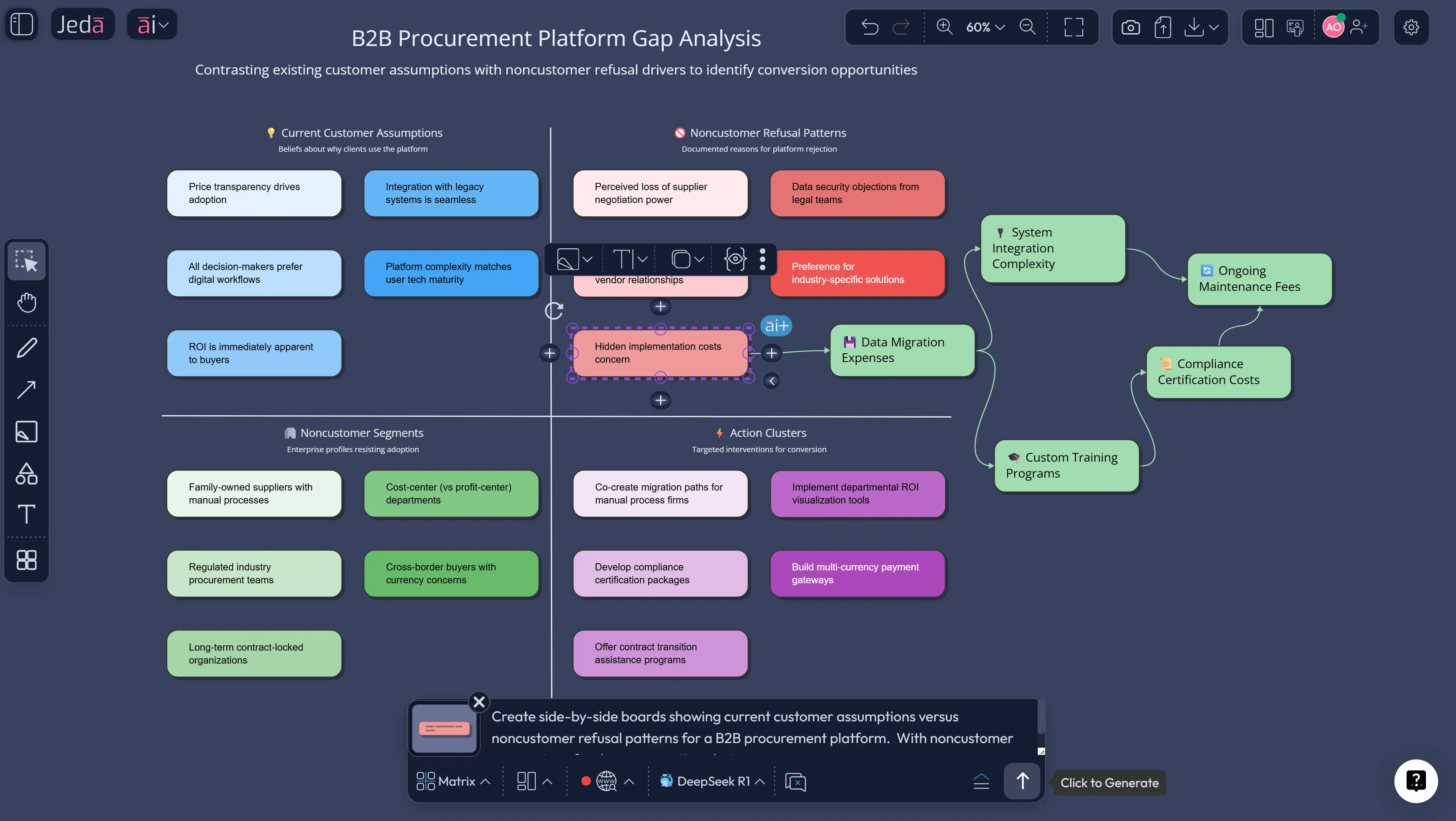
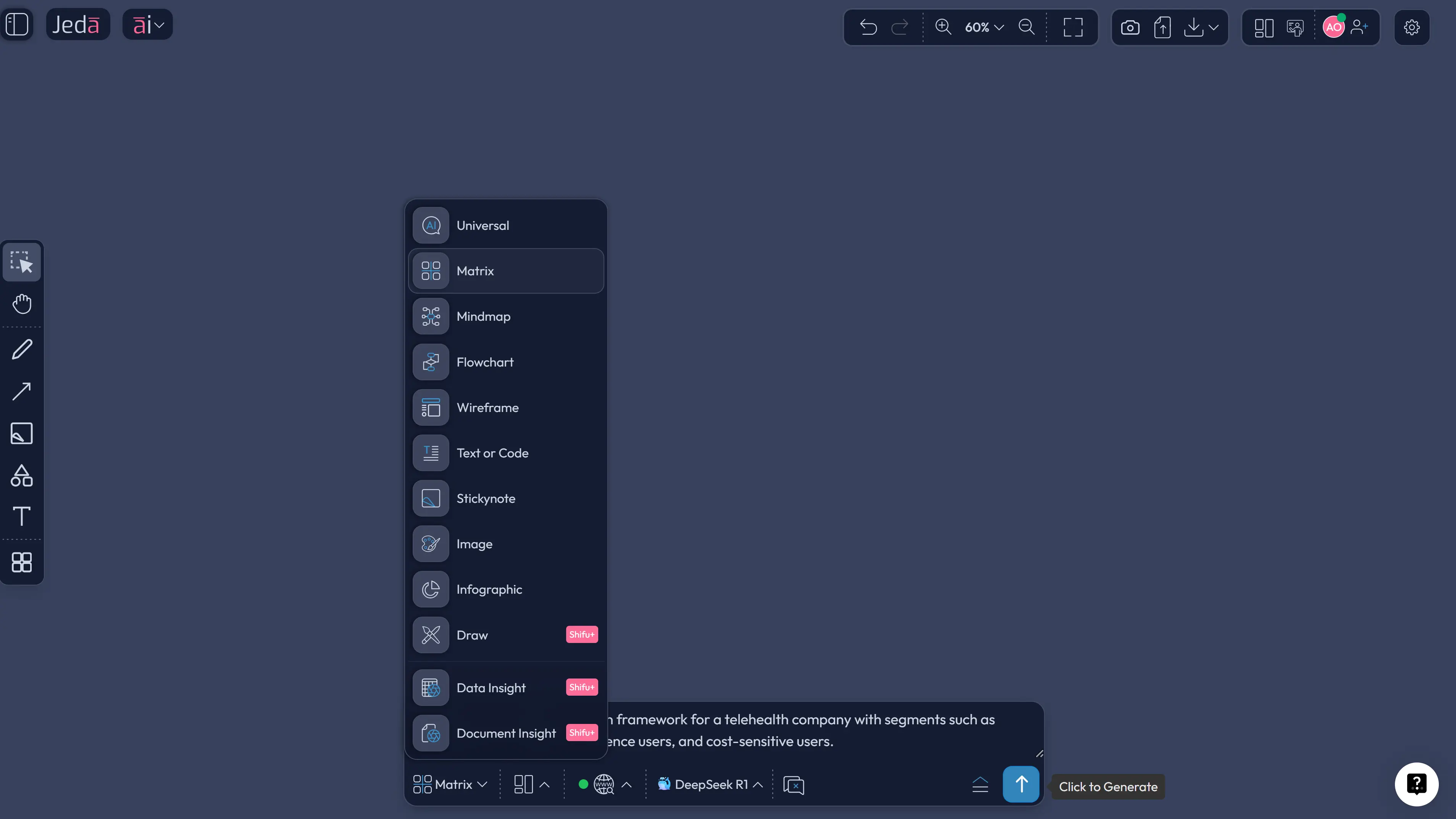
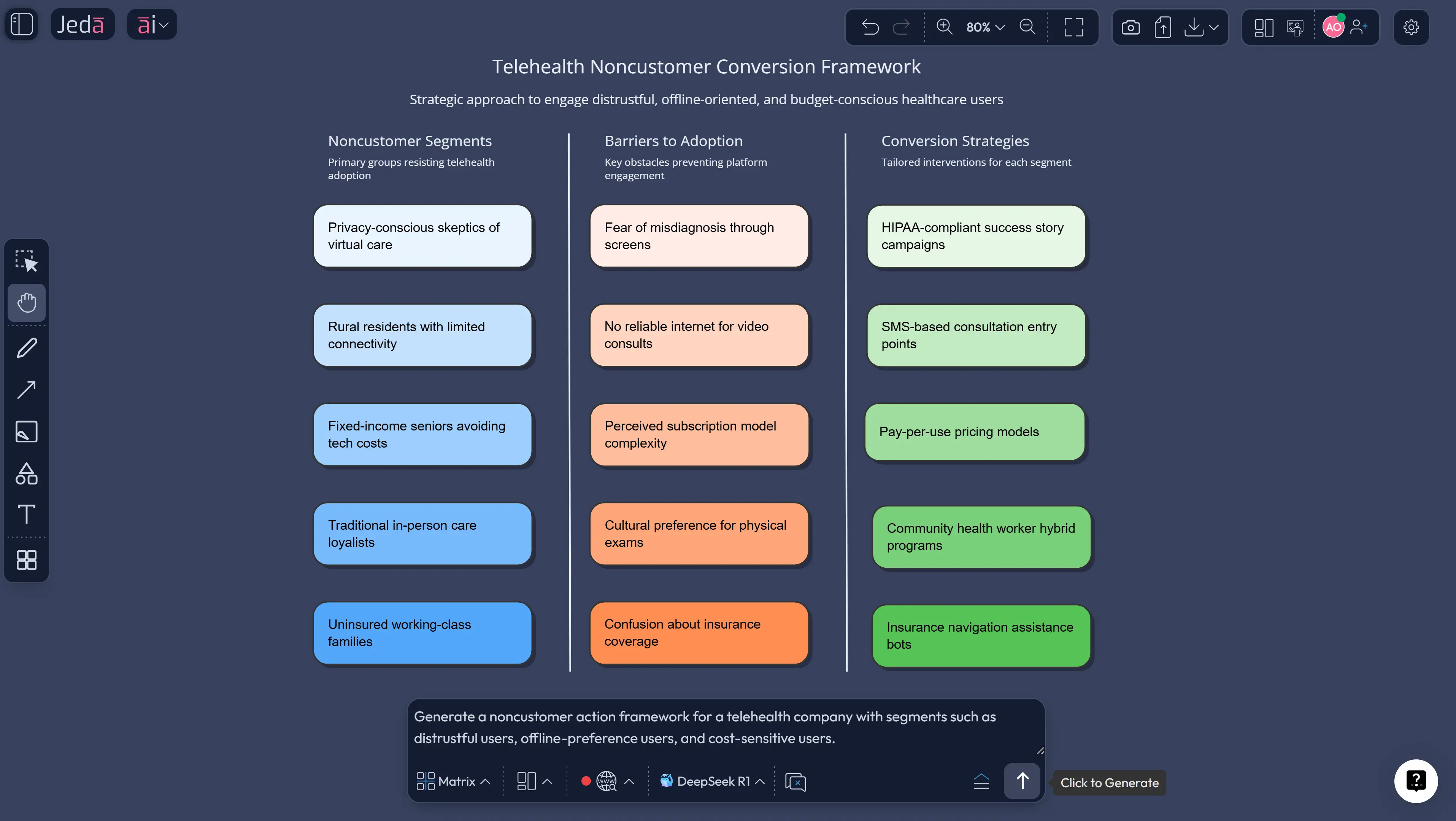
Open the Prompt Bar at the bottom of the canvas and select the Matrix command. Then write a prompt that names the category, suspected noncustomer groups, and the likely barriers to adoption. For example: “Create a noncustomer action framework for a digital mental health service, focusing on people who distrust therapy apps, people who prefer offline support, and people who assume care is too expensive.”
After generation, edit the clusters directly on the board, use AI+ to deepen any segment or action path, and use Vision Transform if you want to convert the output into a journey map, problem tree, or action plan. When you are ready to share, export from Jeda.ai in PNG, SVG, or PDF.
- Open your AI Workspace
Log in to Jeda.ai and enter the workspace where you want to build the Noncustomer Action Framework board.
- Choose the Blue Ocean recipe
Click AI Menu, open Strategy & Planning, choose Blue Ocean Framework, and select Noncustomer Action Framework.
- Define the market and offer
Enter the category, the product or service, and the audience you suspect is not being reached.
- Map noncustomer groups
Generate a first draft that separates likely noncustomer segments and captures why they are not consuming.
- Turn barriers into actions
Refine the board so each barrier leads to a possible strategic action, whether that means changing the offer, experience, access, or narrative.
- Create a custom Prompt Bar version
Use the Matrix command to generate a second framework focused on a specific geography, buyer group, or adoption obstacle.
- Use AI+ to extend the analysis
Tap the AI+ button to deepen refusal reasons, surface overlapping patterns, or draft action priorities.
- Export the working board
Export the board as PNG, SVG, or PDF while keeping the editable version alive in Jeda.ai.
Noncustomer Action Framework template and example
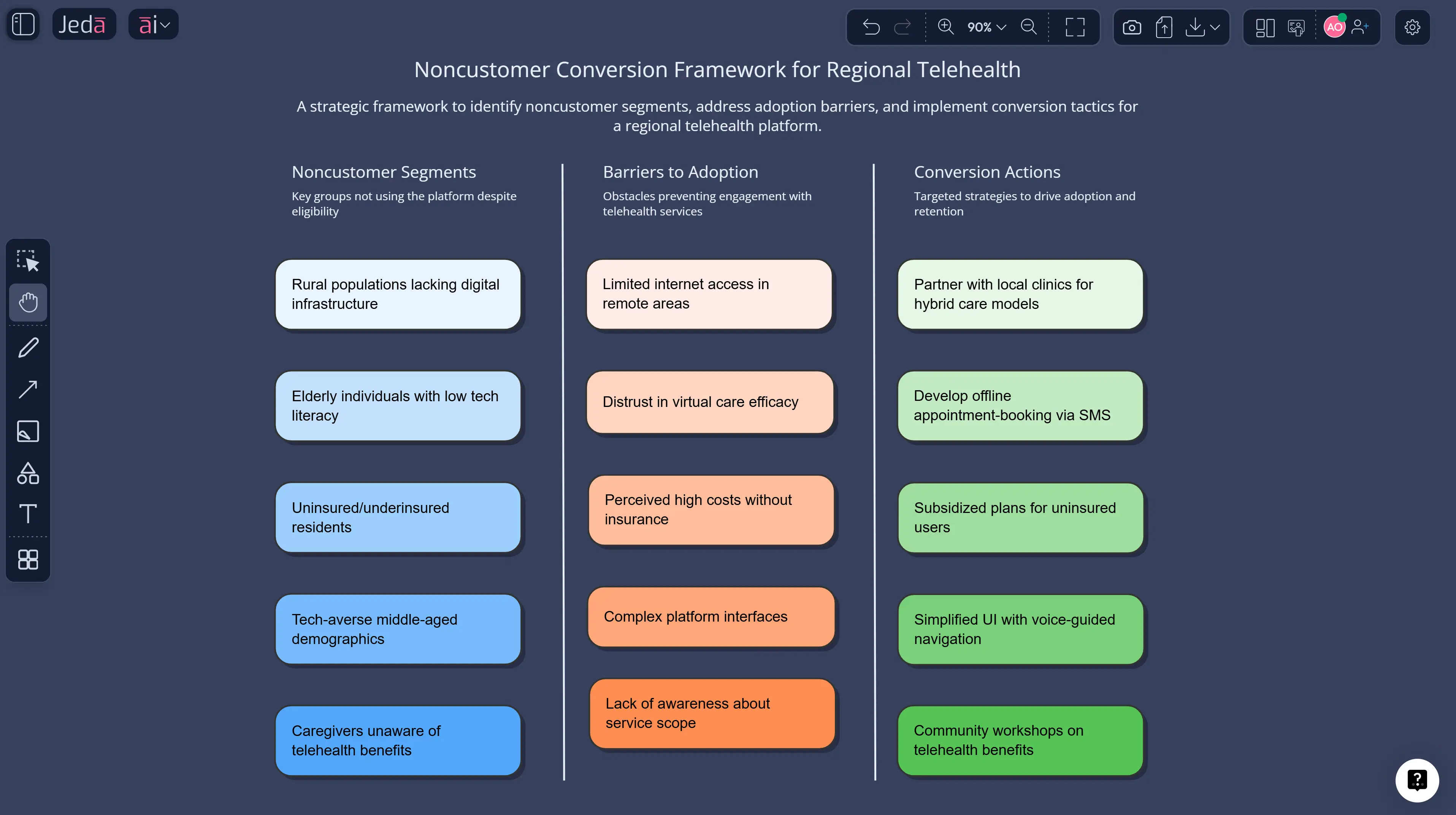
Imagine a regional telehealth provider trying to grow beyond its current customer base.
Current customers love the convenience. But the company has stalled. Why? Because the next wave of demand is not sitting inside the same comfortable user profile. It is hiding among three groups: people who tried digital care once and disliked it, people who assume it is too impersonal to trust, and people who would use it if coordination with local pharmacies and follow-up care were easier.
A normal customer research deck would summarize these as objections. A Noncustomer Action Framework goes further. It asks what should be done.
The first group may need a simpler onboarding and stronger continuity cues. The second may need more human reassurance, clearer clinician identity, and better trust signals. The third may need partnerships, delivery integration, and post-visit guidance. Now the team is not merely describing nonconsumption. It is creating action paths.
In Jeda.ai, that is where the framework becomes practical. You can keep each noncustomer group, barrier cluster, and action response on the same AI Whiteboard, add supporting notes from interviews or market data, and use AI+ to expand promising routes into product decisions, messaging changes, or service design experiments.
Best practices for stronger noncustomer analysis
Common mistakes to avoid
The first mistake is assuming noncustomers are just unaware customers. Sometimes awareness matters. Often the problem is that the category asks for trade-offs they do not accept.
Second, teams often treat all noncustomers as one giant segment. That flattens the analysis and weakens action design.
Third, some organizations collect reasons for non-consumption and stop there. Insight without action is just expensive observation.
Fourth, companies tend to over-interpret what current customers say and underweight what noncustomers actually avoid.
And finally, teams often try to solve noncustomer adoption with messaging alone when the real barrier is offer design, service delivery, or basic trust.
Frequently asked questions
- What is a Noncustomer Action Framework?
- A Noncustomer Action Framework is a practical Blue Ocean-style tool that maps who is not buying, why they are not consuming, and what strategic actions could unlock those groups. It turns noncustomer insight into a working response plan.
- How is this different from the Three Tiers of Noncustomers?
- The Three Tiers of Noncustomers explains where latent demand sits. The Noncustomer Action Framework pushes the team one step further by translating reasons for non-consumption into actions that can reshape the offer, experience, or route to market.
- Can I create a Noncustomer Action Framework with AI?
- Yes. In Jeda.ai, you can generate the framework through the Blue Ocean recipe or by selecting the Matrix command in the Prompt Bar. AI helps cluster noncustomer groups, summarize barriers, and extend the action logic.
- Why use an AI Workspace for noncustomer strategy?
- An AI Workspace keeps the analysis editable, collaborative, and connected. Teams can map noncustomer groups, add evidence, test actions, and keep the work alive instead of trapping it inside a static slide or report.
- What kind of actions belong in the framework?
- Good actions respond directly to the reason for non-consumption. They may involve product redesign, service changes, pricing shifts, easier access, clearer trust signals, or a different delivery model.
- Who should use a Noncustomer Action Framework?
- It is especially useful for strategy consultants, product managers, business leaders, founders, and marketing teams trying to expand demand beyond the current customer base.
- What comes after noncustomer analysis?
- Teams often move from noncustomer action into Strategy Canvas work, ERRC thinking, or Buyer Experience redesign. That helps translate demand insight into a sharper market move.
- Does Jeda.ai support sharing and exporting the board?
- Yes. Jeda.ai supports collaboration in the AI Whiteboard and lets you export the finished framework as PNG, SVG, or PDF while keeping the working board editable.
Sources & further reading
- [1]
Kim, W. Chan; Mauborgne, Renée (2004) . “Blue Ocean Strategy” Harvard Business Review.
View Source ↗ - [2]
Kim, W. Chan; Mauborgne, Renée (2025) . “Three Tiers of Noncustomers” Blue Ocean Strategy Tools.
View Source ↗ - [3]
Blue Ocean Strategy (2021) . “Customers First? How About Noncustomers First?” Blue Ocean Strategy Blog.
View Source ↗ - [4]
Blue Ocean Strategy (2022) . “How to Create Your Blue Ocean Through Noncustomer Analysis” Blue Ocean Strategy Blog.
View Source ↗
Keep the Blue Ocean cluster moving with Three Tiers of Noncustomers with AI, Buyer Experience Cycle with AI, and Value Innovation Canvas with AI. For the broader platform pages, visit /ai-workspace and /ai-whiteboard.
Create your Noncustomer Action Framework in Jeda.ai
Join over 150,000+ users who use Jeda.ai's AI Workspace and AI Whiteboard to turn hidden demand into editable strategic action.
Try Free Template