
One Answer Looks More Certain Than It Is
Students may mistake fluent writing for reliable analysis.
Fits: AI in Business, Generative AI for Managers, AI Fundamentals, Strategic AI Leadership, and AI-Driven Business Transformation.
Students learn: What AI can and cannot do, why answers differ, how instructions change output, how to choose a tool for a business task, and how to preserve human judgment.
Class activity: Compare one business case across multiple models.
Student artifact: Model comparison board.
Assessment focus: Evidence, critique, and final model choice.
Fits: Applied AI, AI Product Management, AI Strategy, AI Implementation, Business Automation, and Agentic Systems.
Students learn: Role definition, instructions, context, skills, boundaries, expected output, and human approval.
Class activity: Create an agent for one course task: give it a role, a skill, boundaries, and an expected output, then mark where a human must approve.
Student artifact: Agent design board.
Assessment focus: Role fit, clarity, evidence, and limits.
Fits: Agentic AI, Business Process Automation, Digital Transformation, AI Governance, and Systems Design.
Students learn: Delegation, sequencing, handoffs, approval, accountability, and escalation.
Class activity: Assemble a small agent team in the sandbox for one case, review the Orchestrator's plan, and mark the human decision points before it runs.
Student artifact: Agent workflow with human decision points.
Assessment focus: Role design, pathway logic, and accountability.
Fits: AI Ethics, Responsible AI, Data Governance, Information Assurance, AI Leadership, and Governance courses.
Students learn: Privacy, bias, security, intellectual property, evidence standards, accountability, and controls.
Class activity: Review an AI-adoption case and stop the workflow for governance approval.
Student artifact: Risk and control board.
Assessment focus: Risk quality, control design, ownership, and justification.
Fits: Strategic Management, Competitive Strategy, AI-Driven Innovation, Business Model Innovation, Consulting Projects, and Capstone.
Students learn: Industry change, competitive pressure, business models, strategic options, scenarios, and trade-offs.
Class activity: Compare evidence, competition, business model, risk, and recommendation.
Student artifact: Defendable strategy canvas.
Assessment focus: Synthesis, options, trade-offs, and defense.
Fits: Business Analytics, Data Analytics for Managers, Business Intelligence, Data Visualization, and Decision Making.
Students learn: Question framing, interpretation, uncertainty, alternative explanations, management action, and communication.
Class activity: Upload data, compare interpretations, and approve a recommendation.
Student artifact: Data-to-decision board.
Assessment focus: Interpretation, evidence, limitations, and action.
Fits: Marketing Analysis, Customer Experience, Market Entry, Digital Marketing, Innovation, and Strategic Marketing.
Students learn: Segmentation, customer needs, competitors, positioning, market risk, and evidence-backed recommendations.
Class activity: Run a market-entry or campaign simulation.
Student artifact: Market recommendation board.
Fits: Digital Transformation, Operations, Supply Chain, Process Design, ERP, Automation, and AI Implementation.
Students learn: Current-state processes, future-state processes, bottlenecks, human and AI roles, controls, and implementation sequence.
Class activity: Redesign a process with human approval points.
Student artifact: Future-state workflow and roadmap.
Fits: Leadership, Organizational Behavior, Change Management, Future of Work, and Human-AI Collaboration.
Students learn: Stakeholder impact, role change, resistance, communication, accountability, and leadership trade-offs.
Class activity: Design a human-AI operating model.
Student artifact: Stakeholder and change plan.
Fits: Business Research, Consulting Projects, Thesis, Dissertation, Applied AI Projects, and MBA Capstone.
Students learn: Research questions, evidence synthesis, agent roles, assumption mapping, recommendation development, implementation, and presentation defense.
Class activity: Build an end-to-end, agent-supported capstone project on a framework-structured canvas and present the defense.
Student artifact: Capstone strategy canvas.
One answer, zero visible reasoning
Students may mistake fluent writing for reliable analysis.
The case, AI chat, notes, spreadsheet, and slides become separate pieces with no shared thread.
Students may paste an AI answer into a SWOT or slide template instead of using the framework to shape the analysis.
You receive the final report, but not the moments where the team accepted, rejected, or changed an idea.
The tool rewards speed. Your course is supposed to reward judgment.
Multi-model reasoning, visible and gradable
Different models often disagree — that disagreement becomes something to investigate, not hide.
The case, documents, data, sources, and assumptions remain together, not scattered across tabs.
SWOT, Five Forces, Value Chain, decision matrices, and 300+ named frameworks structure the analysis as it happens.
Feedback stays beside the evidence, framework, or recommendation it improves.
Students don't have to stitch together separate chats at the deadline.
Use structured frameworks for SWOT, Five Forces, risk analysis, decision matrices, competitive analysis, and other course methods.
Use mind maps for stakeholder relationships, causes, strategic options, market structure, and topic decomposition.
Use connected visual structures for operating models, decision flows, systems, transformation work, and process design.
Bring supported case documents, reports, policies, presentations, and course readings into the workspace.
Bring supported CSV and Excel files into the workspace and connect findings to management action.
Bring current market, competitor, regulatory, and customer evidence into supported workflows.
Students can add evidence, compare AI answers, edit frameworks, mark weak assumptions, ask questions, build scenarios, revise recommendations, and present together.
A full AI powerhouse — the most powerful language, reasoning, and image models packed together for every use case. Jeda.ai's Multi-LLM Agent runs multiple models simultaneously, picks the best output, and delivers smarter results than any single model alone.
Introduce the case, concept, and decision students must make. Upload a case study PDF, or describe the decision — "Porter's Five Forces for a mid-size SaaS company entering the EU market" — and Jeda.ai understands the strategic context instantly.
PDF, Word, CSV
No special syntax
"Porter's Five Forces analysis for a mid-size SaaS company entering the EU market, competing against 2 incumbents"
Students state an initial view before seeing AI answers. Then choose AI Mindmap, AI Matrix, or AI Diagram scoped to the course topic — competitive strategy, decision-making, organizational design, or applied capstone work.
Case breakdowns
SWOT, BCG, Ansoff
Teams run the same prompt across several AI models and identify agreement, disagreement, unsupported confidence, and missing evidence. The reasoning trail is the teaching moment, not just the output.
Compare, don't trust one
From a case prompt
Bring in permitted course documents and current research. AI generated the framework — now enrich it with real-time web search so the analysis reflects this quarter, not stale training data.
Live market data
Always current
Teams organize the reasoning in the appropriate matrix, diagram, or framework — the shape of the work is the grading rubric, visible to the instructor in real time.
Every team, live
Review each team's work on its board
Challenge evidence, assumptions, risks, and trade-offs. Students revise the work, present the final decision, and export as PNG, SVG, or PDF for the gradebook.
PNG, SVG, PDF
For your LMS and handouts
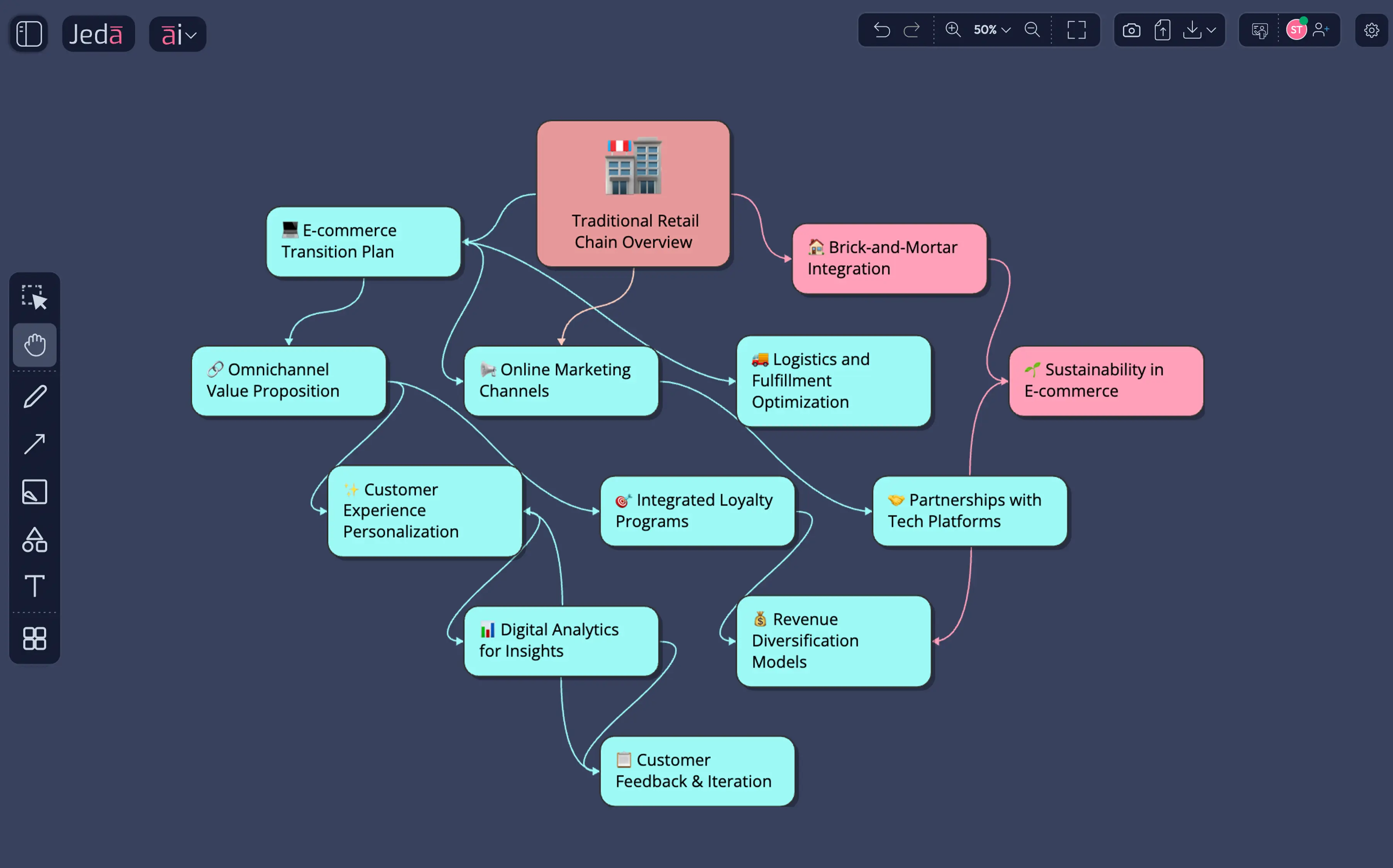
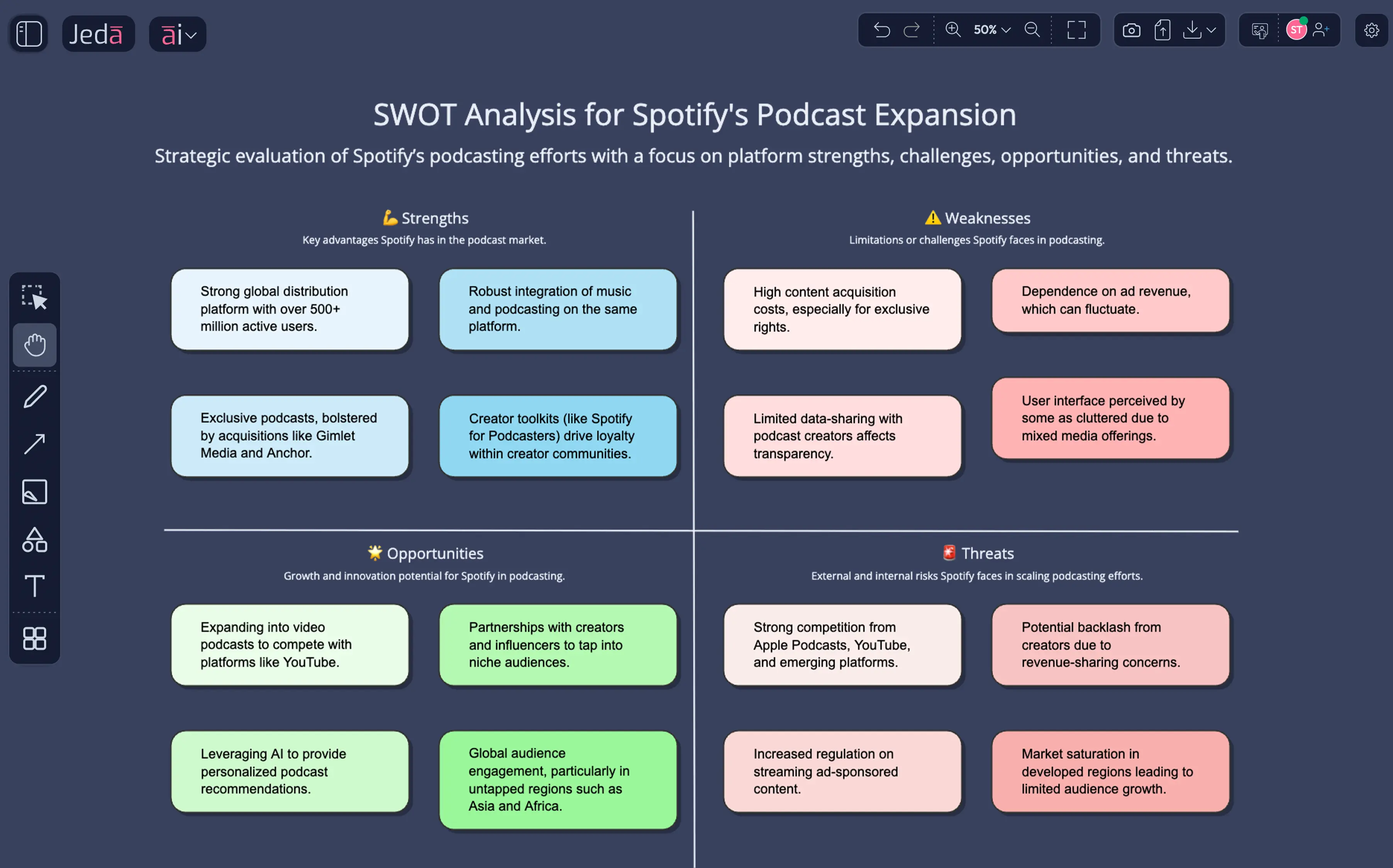
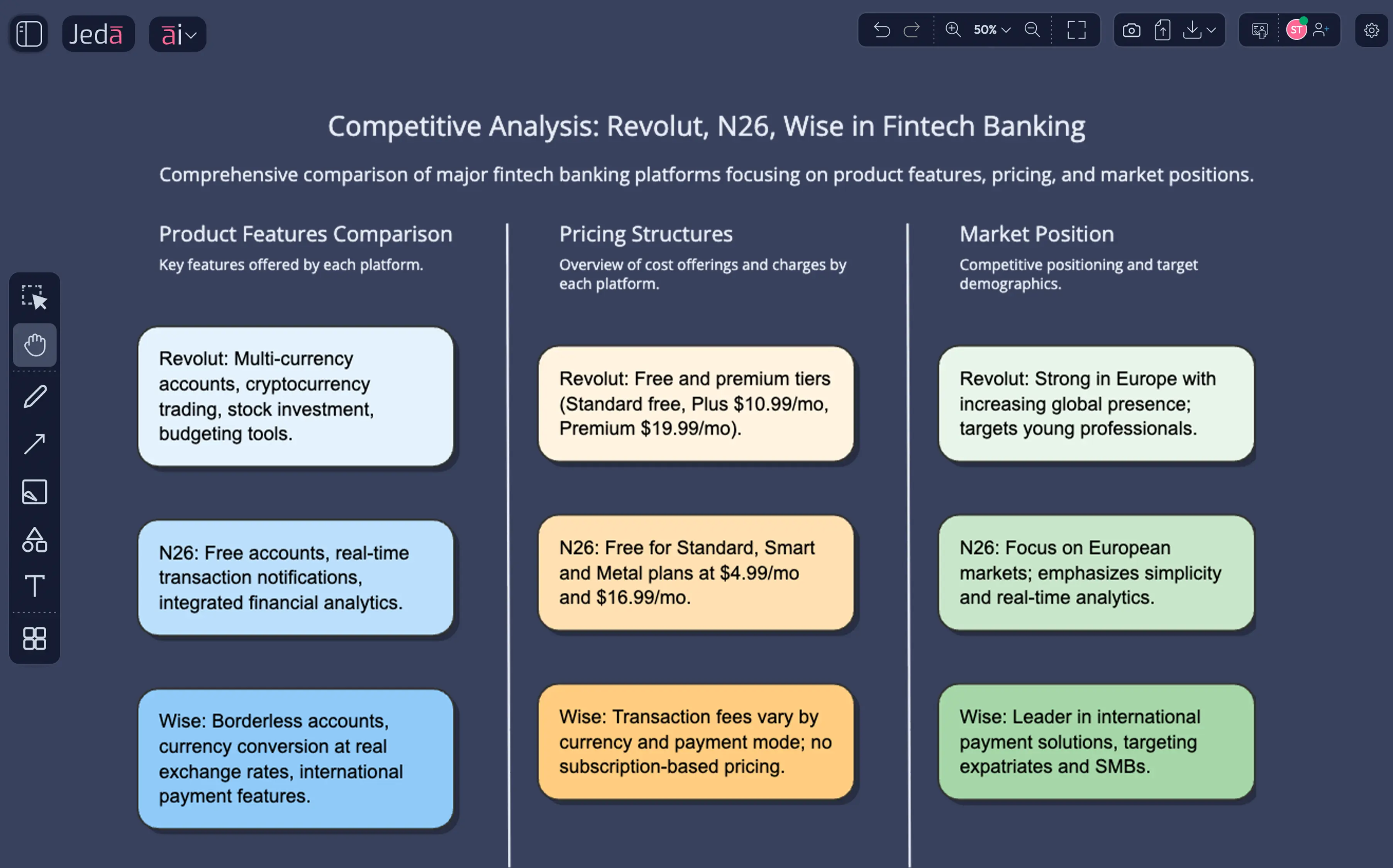
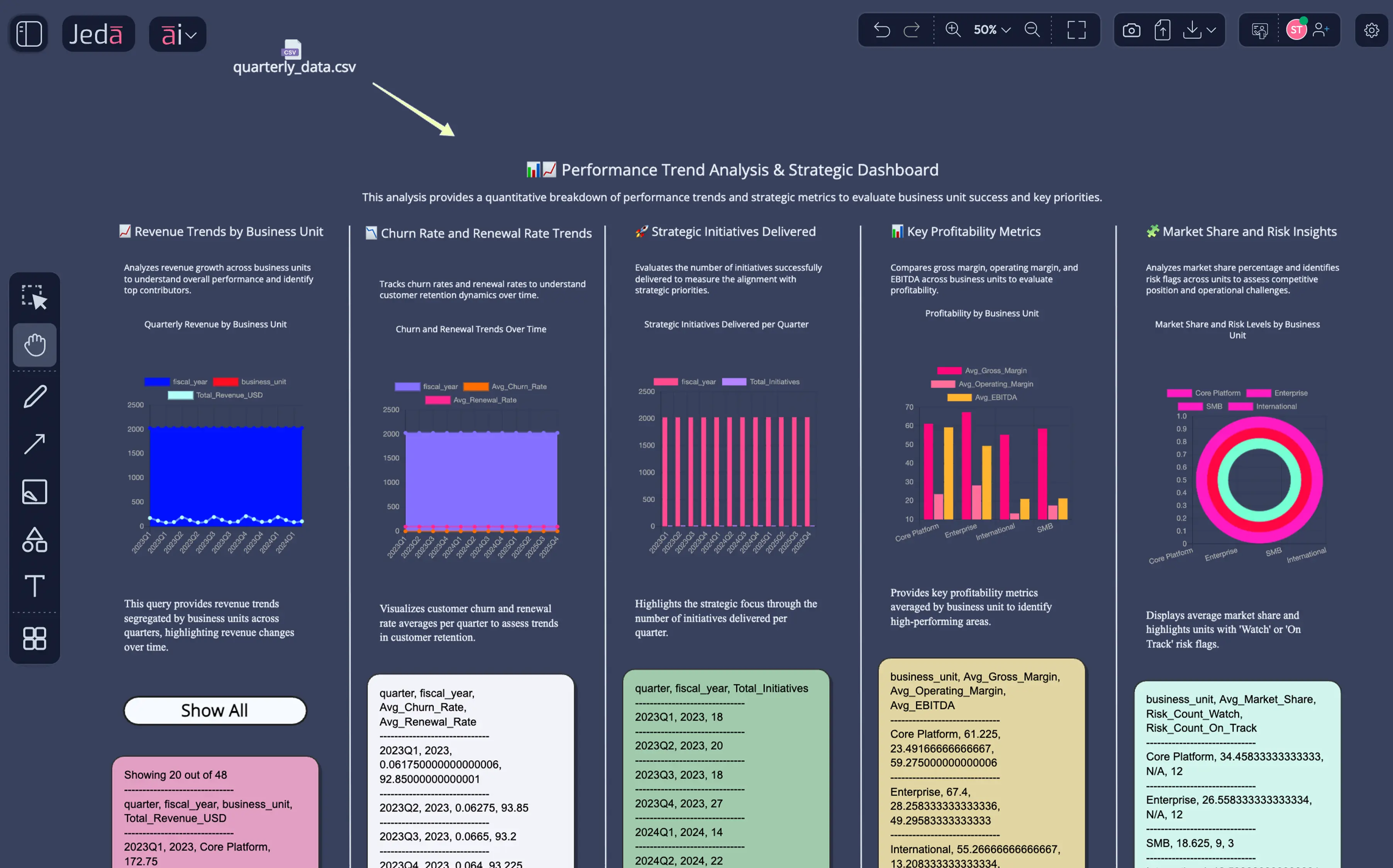
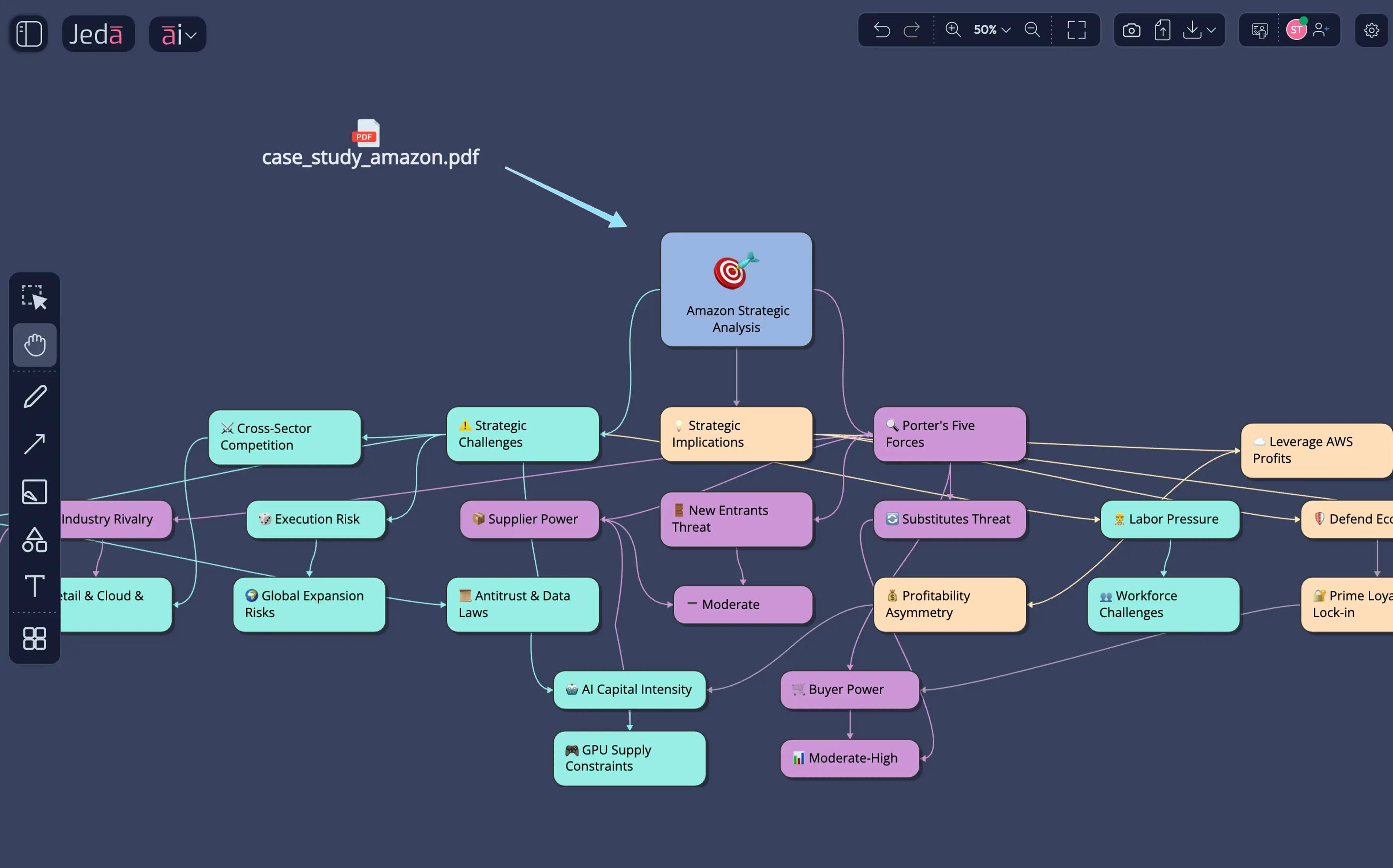
Students examine evidence, assumptions, missing information, confidence, risks, alternatives, and recommendations — not just which answer sounds most confident. What you can assess: model choice, evidence quality, critique, limitations, and human judgment.
Different models often frame the same business problem differently. Students investigate why instead of accepting the first fluent answer.
Course documents, datasets, permitted external research, assumptions, and conclusions stay together on the same canvas.
Students must decide which evidence is strong enough, which assumption is acceptable, which risk needs a control, and what the final recommendation should be.
Frameworks turn vague AI prose into something the instructor and class can actually inspect.
You define the learning objective, when AI enters, what counts as evidence, which decisions require approval, and how the work is assessed.
Instructor's guide to bringing AI into your Ethics, Sustainability, and Governance course — what changes and how to teach it.
Instructor's guide to bringing AI into your Digital Transformation course — what changes and how to teach it.
Instructor's guide to bringing AI into your Business Analytics and Decision Making course — what changes and how to teach it.
Instructor's guide to bringing AI into your Capstone and Consulting Projects course — what changes and how to teach it.
Browse the full set of course-by-course AI guides for MBA instructors.
Give an agent one clear business role — Financial Analyst, Competitive Analyst, Data Analyst — with the course material it should use and the limits you set.
A skill is the method an agent follows. Select a ready skill, or create, upload, or edit your own: SWOT analysis, valuation review, stakeholder mapping, market evaluation, strategic risk analysis.
Put the agents a case needs into a team sandbox, add the case question and shared files, and keep each agent's own files with that agent. "Which expert is missing?" becomes a class discussion.
Before anything runs, the Orchestrator lays out who does what, in what order, and what is missing. You or your students approve the plan, then judge the evidence it produces.
Structure a case around evidence, assumptions, stakeholders, alternatives, and decision criteria.
Let students join the same workspace rather than disappearing into separate chats.
Run and present the activity from the workspace while students contribute actively.
Use one persistent workspace for hybrid, online, and distributed group work.
Use SWOT, Five Forces, Value Chain, and other frameworks during the analysis.
Turn business data into a management recommendation with visible limitations and trade-offs.
Make students evaluate privacy, bias, evidence, intellectual property, and accountability.
Bring research, documents, data, frameworks, collaboration, and recommendations together.
Students compare multiple supported AI models on the same canvas and investigate why the reasoning differs.
SWOT, Porter's Five Forces, Business Model Canvas, and hundreds more, built in.
Bring current sources into an analysis where the assignment allows it.
Convert a case breakdown into a study guide, or a strategy diagram into an exec summary.
Students and instructors work the same canvas together, live, from any device.
Select any node on the canvas and ask AI to drill into supporting detail or a real-world example.
Supported course documents become structured visual analysis that students must review and verify.
Supported spreadsheet files become visual analysis connected to business decisions.
The instructor can run and present the workspace directly during class.
The work stays as editable Jeda.ai visuals your class can revise together.
We can work with your institution's existing security and privacy review process.
| Feature | Jeda.aiAI-First | ChatGPT / Copilot | Miro | Notion AI |
|---|---|---|---|---|
| AI Visual Case Analysis | Prompt → framework canvas | Text only | Generic whiteboard | Text/doc only |
| Multi-Model Comparison | Multi-Model + Aggregator | Single model | Single AI assist | Single model |
| Unlimited AI Content | Unlimited | Limited | Limited | Limited |
| Document to Frameworks | Case PDF → structured canvas | Limited | Limited | |
| Data Insight | Dataset → board slide | Limited | ||
| 300+ Business Frameworks | SWOT, Porter's + 300 more | Limited | ||
| Real-Time Collaboration | Multi-user canvas + AI | |||
| Pricing | Free / $10/user/mo | $20/mo | Free / $10/user/mo + limited AI credit | $10/user/mo add-on |
Comparison based on publicly available information as of March 2026.
Can students explain why AI answers differed?
Can students show what supports the recommendation?
Can they explain what they approved, rejected, or changed?
Can you see contribution, critique, and synthesis more clearly?
Can students define a useful agent role, method, boundary, and output?
Did the framework shape the reasoning?
Can students explain alternatives, trade-offs, risks, and implementation?
Can you use the activity again without rebuilding it?
Did the class create enough value to justify a larger pilot?
Jeda.ai can work with your institution's existing security and privacy review process.
Read the Security FAQ, and ask us for current security and privacy documentation during evaluation.
You define the learning objective, when AI enters, what counts as evidence, what students must disclose, and how the work is assessed.